R-410A is the next R-404A: what it means for your chillers and comfort cooling
R-410A is following the same path R-404A took in 2017–18: scarce, expensive and on its way out. In November 2025, UK contractors were paying £15–20 per kg for R-410A. By October 2026, the price had reached £80–100 per kg. Some suppliers are now rationing it.
That matters if your site runs chillers, VRF or split comfort cooling. Around 2.3 million R-410A systems were still in service in Great Britain in 2025, and most rely on top-ups to keep running.
This guide explains:
- Why R-410A prices have risen so sharply
- What the R-410A phase out actually means under GB F-Gas rules
- Why finding an R-410A replacement is harder than it was for R-404A
- Your three practical options: maintain, retrofit or replace
It's written for facilities managers, estates teams and engineers who need to keep plant running and budgets predictable.
Is R-410A being banned in the UK?
No. There is no outright ban on using or servicing existing R-410A systems in Great Britain. It is being squeezed out in two other ways: bans on some new equipment, and a shrinking supply of HFCs.
1. Bans on some new equipment
Since 1 January 2025, new single split air-conditioning systems holding less than 3 kg of refrigerant with a global warming potential (GWP) of 750 or more can't be placed on the GB market. R-410A has a GWP of 2,088, so new small single splits now use alternatives such as R-32. Existing systems can still be serviced. (IOR guidance)
2. The HFC phase-down and the 2027 F-Gas quota cut
The bigger pressure is supply. Under the GB F-Gas Regulation, the amount of HFC that can be placed on the market is capped by quota and measured in tonnes of CO₂ equivalent. High-GWP gases such as R-410A use up quota fastest.
- January 2027: the GB quota falls by 23% year on year.
- Defra confirmed in May 2026 that it won't bring in new GB legislation in 2026 to change that step, so the cut goes ahead. Wider reform of the GB phase-down has been delayed. (Cooling Post; Defra consultation)
- The EU is going further. Its 2027 cut is around 50%, with another steep cut in 2030 and a long list of new equipment bans under Regulation (EU) 2024/573.
- Northern Ireland already follows the EU F-Gas Regulation under the Windsor Framework. If you operate sites there, EU rules apply.
Defra's consultation proposed a phase-down similar to the EU's. Expect GB rules to tighten, not loosen.
Why has the R-410A price increased so much in the UK?
R-410A prices have risen because the market expects quota to run short, and R-410A eats quota fast.
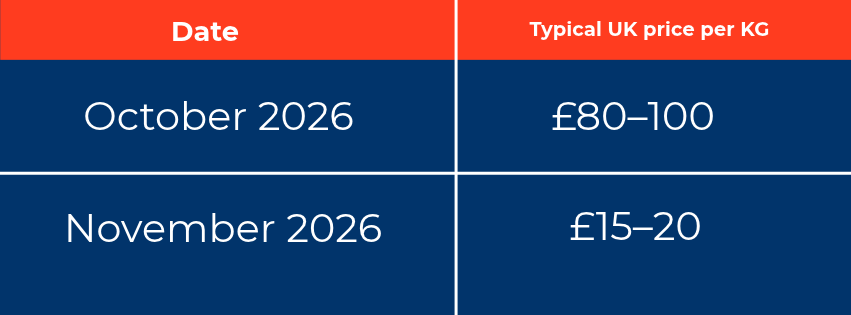
Three things are driving the R-410A price increase in the UK:
- Quota cost. Each kg of R-410A counts as 2.088 tonnes CO₂e against an importer's quota. Ahead of the 2027 cut, suppliers would rather use that allocation on lower-GWP gases.
- Rationing. Some suppliers are limiting volumes. Others may stop selling R-410A altogether because it "uses up too much quota".
- Heatwave demand. Summer 2026 was the UK's hottest on record at 16.5°C. AC installers were flat out, and reactive repairs drew down stocks.
We've seen this before. R-404A prices spiked in 2017–18 as the phase-down bit, and the gas effectively disappeared from new equipment soon after.
Why is R-410A harder to replace than R-404A?
When R-404A became scarce, operators had ready drop-in alternatives. R-410A has no obvious equivalent.
- No A1 drop-in. R-404A systems could be retrofilled with non-flammable (A1) blends such as R-448A and R-449A, and many were. R-410A runs at much higher pressures, and no like-for-like A1 replacement exists. Trials of mildly flammable A2L gases for retrofill are ongoing but unproven.
- Recovery is harder. R-404A sat in large supermarket systems, where it could be recovered and reused at scale. R-410A is spread across millions of small systems, and too much of it is vented at end of life.
- No refrigerant bank to draw on. Supermarkets built up their own stock of recovered R-404A. Nothing similar exists for R-410A.
There's also a compliance risk. As prices climb, illegal imports could grow. Some technicians may be tempted to top up R-410A systems with R-32, a different refrigerant. Both put your equipment, warranty and F-Gas compliance at risk.
What refrigerant replaces R-410A?
There's no single R-410A replacement. The right choice depends on the application, the capacity and where the plant sits. For new equipment, the main options are:
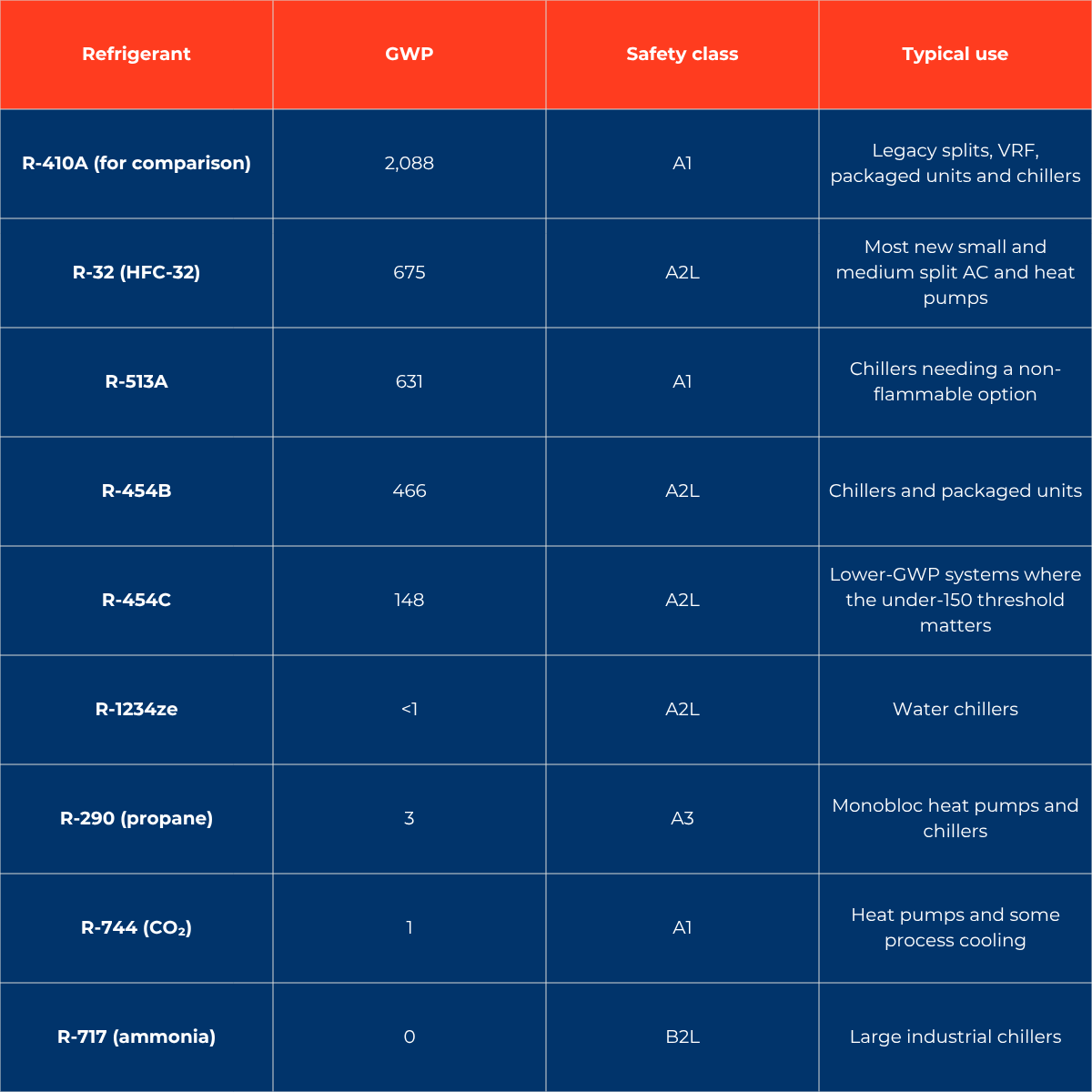
GWP figures are on the 100-year (AR4) basis used in F-Gas rules. A1 is non-flammable, A2L mildly flammable, A3 highly flammable and B2L toxic and mildly flammable.
Two cautions:
- R-32 is not the end point. It's now the default in new splits, but at a GWP of 675 there's no clear view of what comes after it.
- Under 150 GWP is where regulation is heading. Many sectors are moving towards sub-150 GWP gases too slowly. Plant you buy now should be planned with that threshold in mind.
What should you do with R-410A chillers and comfort cooling?
Option 1: Maintain and contain
Best for systems in good condition with years of life left.
- Find and fix leaks fast. Every kg lost now costs up to five times what it did a year ago.
- Recover, never vent. Venting is illegal, and recovered gas can keep your other R-410A plant running.
- Never let anyone top up an R-410A system with R-32 or gas of unknown origin.
- Planned maintenance also protects resilience. In the 2026 heatwaves, chillers tripped on extreme condensing temperatures.
Option 2: Retrofit
Retrofit has limited scope for R-410A. Unlike R-404A, there's no proven A1 drop-in. Any A2L retrofill needs a proper engineering and safety assessment covering pressures, components, charge limits and the space the plant serves. Don't assume it's possible until it's been surveyed.
Option 3: R-410A chiller replacement
Best for plant that is ageing, leaking repeatedly, undersized for hotter summers or inefficient. Replacement lets you:
- Move to a lower-GWP refrigerant and cut quota and price exposure
- Right-size capacity for a climate that's warming fast. Gatwick averaged 29 cooling degree days a year over 20 years, and 46 over the last four.
- Improve efficiency. Refrigeration and air conditioning use around 16% of UK electricity. See [how maintenance supports decarbonisation]
- Avoid a rushed, reactive replacement when a system fails in peak season. If continuity is critical, read about [critical cooling response times]
How Cooltherm helps you plan your R-410A transition
The first step is knowing exactly what you have. Most sites don't. Cooltherm's extensive team of experienced engineers, working from four regional offices, survey chillers and comfort cooling across the UK. A Cooltherm site survey gives you:
- A refrigerant register: every system, its refrigerant, charge, age and CO₂e, so you know your R-410A exposure.
- Leak risk and compliance: a check on condition, leak history and whether leak check frequencies are being met.
- Resilience: whether your plant can hold temperature in a 2026-style summer.
- A prioritised plan: which systems to maintain, which to assess for retrofit, and which to replace, and when.
That turns R-410A from a rising, unpredictable cost into a plan you can budget for.
Book your Cooltherm site survey
Don't wait for a failure in next summer's heat or a quote that's doubled. [Book a site survey] and find out where your R-410A plant stands before the 2027 F-Gas quota cut takes effect.
R-410A FAQs
Is R-410A being banned in the UK?
No. You can still use and service existing R-410A systems in Great Britain. New single split AC systems under 3 kg with a GWP of 750 or more have been banned since January 2025, and the HFC quota cut in January 2027 will tighten supply further.
What is the R-410A phase out?
The R-410A phase out is the gradual removal of R-410A from the market through the HFC phase-down. Quota limits make high-GWP gases like R-410A (GWP 2,088) scarcer and more expensive, while bans stop it being used in some new equipment.
What refrigerant replaces R-410A?
It depends on the application. R-32 is the most common R-410A replacement in new split systems. Chillers increasingly use R-454B, R-513A, R-1234ze, R-290 or, for large industrial plant, ammonia.
Can I top up an R-410A system with R-32?
No. R-32 is a different refrigerant with different properties and a different safety class. Mixing or substituting refrigerants risks damage, voids warranties and can breach F-Gas rules.
How much does R-410A cost in the UK?
In October 2026, UK prices were typically £80–100 per kg, up from £15–20 in November 2025. Some suppliers are rationing supply.
What are the R-410A leak check requirements?
A system holding 2.4 kg or more of R-410A (5 tonnes CO₂e) needs a leak check at least every 12 months. From 24 kg it's every 6 months, and from 240 kg every 3 months, with a leak detection system required. Fitting leak detection halves the frequency at the first two levels.
What does the F-Gas quota cut in 2027 mean for me?
From 1 January 2027, the GB HFC quota falls by 23%. Expect higher prices and tighter supply for high-GWP refrigerants, particularly R-410A.
Should I replace my R-410A chiller now?
Not automatically. If it's in good condition, maintain and contain. If it's ageing, leaking or struggling in hot weather, plan an R-410A chiller replacement before it fails. A site survey will tell you which applies.
Related News

Heating and Cooling at the Same Time: Is Your Factory Missing an Energy-Saving Opportunity?
The Best Time to Prepare Your Chiller for Next Summer? Right Now.