Mission-Critical Cooling: Why Response Time Is the Metric That Actually Matters
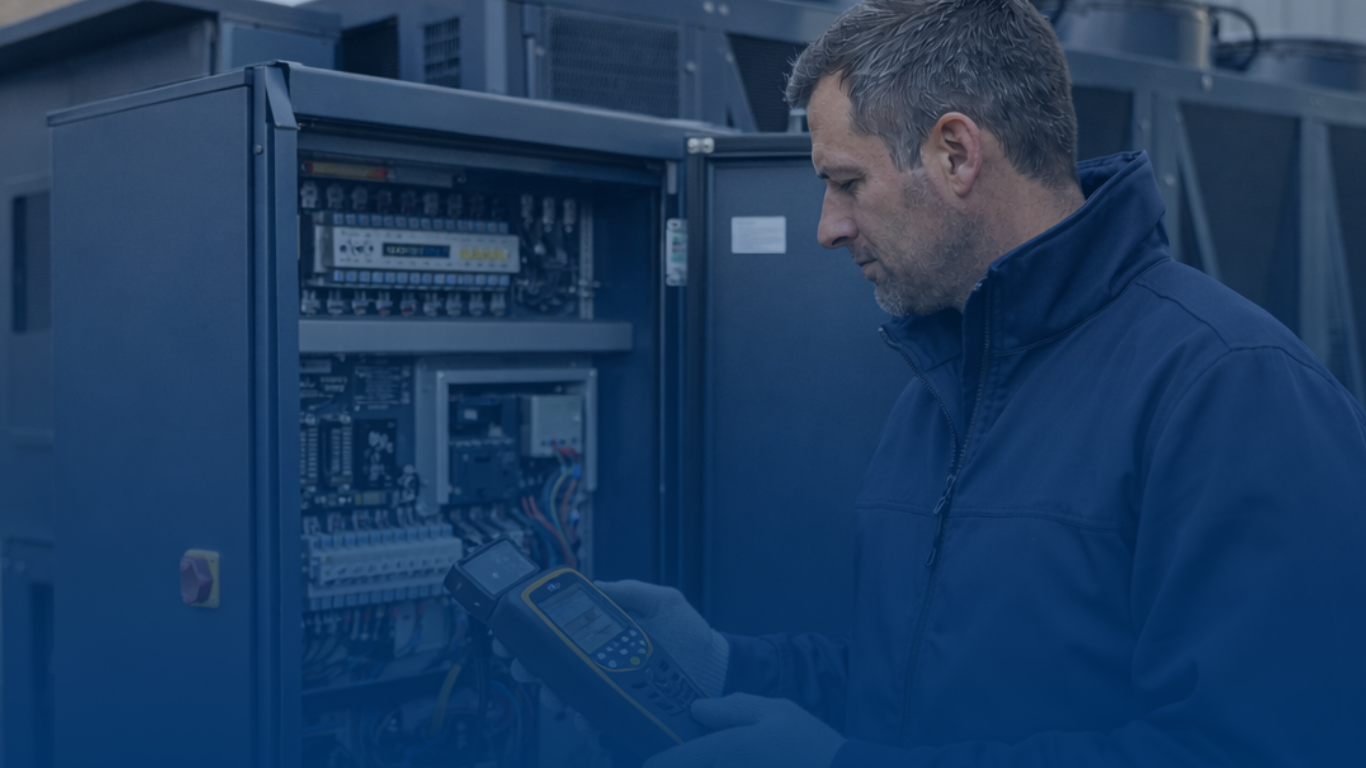
In a critical cooling environment, you do not measure failure in hours. You measure it in minutes — and sometimes in seconds. A high-density server cabinet can exceed safe operating temperatures inside 60 seconds of cooling loss. A modern GPU rack running an AI workload can throttle in under three minutes. By the time a traditional maintenance call-out is logged, triaged and dispatched, the damage is often already done.
This is why response time — not equipment specification, not capacity, not even redundancy ratio — is now the single most important variable in data centre cooling, hospital cooling, and any other mission critical cooling system across the UK. The chiller you buy matters. The framework that responds when it falters matters more.
This guide explains what makes a cooling environment "critical", how quickly things escalate when cooling fails, what downtime actually costs, and what a credible response model looks like. It is written for facility managers, M&E consultants, IT operations leaders, and anyone whose risk register includes the words cooling failure.
What is a critical cooling environment?
A critical cooling environment is any facility where loss of temperature control causes immediate operational, financial, or safety consequences — rather than mere discomfort. The defining characteristic is that the cooling system is part of the production line, not a comfort utility.
Typical critical cooling environments include:
- Data centres and colocation facilities — where servers throttle or shut down on over-temperature protection
- Hospitals and healthcare facilities — where operating theatres, MRI suites, pharmacy stores, and pathology labs depend on precise environmental control
- Financial services trading floors and exchange data halls — where downtime is measured in lost transactions per second
- Defence and government secure sites — where uptime obligations are contractual and non-negotiable
- Pharmaceutical and life sciences manufacturing — where cold-chain breaches can scrap entire batches
Industrial process cooling applications — where temperature drift directly degrades product yield
The common thread across all of these is asymmetry: the cost of preventing a cooling event is small, predictable and budgeted. The cost of responding to one once it has happened is large, unpredictable, and often unbudgeted. This asymmetry is exactly why response time is the defining metric.
How fast can a cooling failure escalate?
Faster than most operators expect. Heat builds in a critical environment far quicker than cooling capacity can be re-established.
Independent analysis of cooling failure dynamics shows that a complete loss of cooling can drive temperatures up by several degrees Celsius per minute, depending on rack density and room volume. Industry simulators built on ASHRAE TC 9.9 thermal guidelines and the lumped-capacitance method indicate that GPU clusters at 40 kW per rack can cross the throttling threshold in under three minutes even when only two CRAC units are lost. A 15 kW blade cabinet can exceed safe operating temperature within 60 seconds of total cooling loss. Heat does not wait politely while the on-call engineer drives across the M25.
Worse, the rise is not linear. As internal server fans accelerate to compensate, they draw in more of the already-warm air, accelerating the temperature climb. This is the positive feedback loop at the heart of thermal runaway: each second of delay does not just add risk, it compounds it.
This is the engineering reality that makes data centre cooling response time so consequential. ASHRAE guidelines recommend temperature fluctuations of no more than 5°C over 60 minutes to protect equipment life — yet a real cooling failure can blow through that envelope in a tenth of the time. Even when cooling is restored, temperatures can continue to rise if the system lacks the excess capacity to reabsorb the heat already accumulated.
In short: by the time a typical reactive maintenance contract is acted on, you are no longer trying to prevent damage. You are trying to contain it.
What does a cooling-related outage actually cost?
The headline figures are sobering, and worth knowing in detail.
- The Uptime Institute's 2024 outage analysis found that cooling issues accounted for 19% of impactful data centre outages — the second leading cause behind power. (source)
- The ITIC 2024 Hourly Cost of Downtime survey found that 97% of large enterprises report downtime costs exceeding $100,000 per hour, and 41% report costs above $1 million per hour.
- Gartner's widely-cited benchmark puts average data centre downtime at approximately $5,600 per minute — roughly $336,000 per hour. (source)
- Research by the Ponemon Institute found that among downtime events specifically caused by cooling system failures, the average incident cost exceeded $687,000.
These numbers underplay the real picture, because they exclude what most boardrooms care about most: SLA penalties, reputational damage, regulatory exposure (HIPAA in healthcare, FCA expectations in financial services), and customer attrition that can linger for years after a single visible outage. For a colocation provider with shared tenants, one extended cooling event can trigger cascading SLA penalties across an entire client base simultaneously.
Set against that backdrop, the case for investing in critical cooling systems with built-in response speed is simply mathematical. The U.S. Department of Energy has reported that preventive maintenance programmes can reduce HVAC energy consumption by 15–20% while extending equipment life by 30–50% — and facilities running systematic preventive maintenance report 58% fewer downtime incidents than those relying on reactive call-outs.
What factors determine cooling response time?
Response time is not a single number. It is a stack of dependencies that either compress or extend the gap between fault detection and fault resolution. The major factors are:
1. Monitoring and alerting latency. How long does it take for a deviation in chiller performance, refrigerant pressure, condenser fan speed, or chilled water temperature to register as an alert? Modern critical infrastructure runs sub-minute polling on key sensors. Older sites can be running 15-minute averages — a window in which a thermal event can complete before anyone is even notified.
2. Diagnostic depth. When the alert lands, can the operator immediately identify the cause, or does it trigger an investigation? Specialist providers with deep familiarity with the specific make and model of installed plant — for example, Turbocor or other inverter-driven chillers — diagnose in minutes what a generalist takes hours to work through.
3. Geographic coverage. The number of qualified engineers within a one-hour drive of the site is, in many cases, the single biggest determinant of recovery time. For UK critical infrastructure, this is why national service networks with regional engineering bases consistently outperform single-depot providers.
4. Parts availability. A diagnosis is not a fix. If the failed component — a compressor, an expansion valve, a control board — is not in van stock or at a regional warehouse, the clock keeps ticking. Critical cooling providers run parts pre-positioning strategies that mirror the equipment they have under contract.
5. Authorisation and training depth. Manufacturer-authorised engineers can act on systems without waiting for sign-off from a third party. For premium kit (Daikin, Mitsubishi Electric, Danfoss Turbocor®), this credential matters — it removes hours from the recovery window.
6. Contractual response SLA. A genuine 24/7 critical-infrastructure contract is not the same as a 24/7 phone line. It guarantees an engineer dispatched and on site within a defined window, not just a voicemail acknowledged.
The fastest response time on paper is meaningless without all six. Operators evaluating an industrial chiller maintenance contract should test the provider against each one.
How can businesses reduce cooling response time?
Reducing response time is not about heroics on the day of failure — it is about decisions made months or years earlier. The practical playbook looks like this:
- Specify N+1 redundancy as a minimum for any production critical environment, and 2N for ultra-critical operations (financial trading, life-safety healthcare, defence). Redundancy converts a catastrophic failure into a containable one and buys back the minutes you need.
- Run failure simulations, not just commissioning tests. Modelling a complete cooling outage tells you the exact temperature trajectory of your specific facility — and exposes the gap between alert and unsafe inlet temperature for each rack class.
- Contract for guaranteed on-site response windows, not generic "24/7 cover". Define the SLA in minutes-to-site, not hours-to-acknowledge.
- Choose a service partner with manufacturer-authorised technicians on the specific platforms installed. Authorisation removes warranty and access friction.
- Insist on parts pre-positioning for known failure points: compressors, control boards, sensors, expansion valves, contactors.
- Maintain a tested temporary cooling fallback — a plan for rental or portable cooling that can be deployed inside the response window, particularly important during the UK's increasingly extreme summer ambients.
- Invest in preventive maintenance, not just reactive. The Department of Energy figures cited above are not theoretical — proactive servicing genuinely halves the incident rate.
Each of these reduces the response window by a measurable amount. Taken together, they convert the difference between a near-miss and a headline.
Why does Cooltherm's response framework outperform reactive maintenance?
Cooltherm was established in 1992 and has spent over three decades building precisely this kind of response framework for UK critical infrastructure. The model rests on a few specific structural choices that compound into faster real-world response:
- Five regional offices and over 50 qualified field engineers, giving genuine national reach and short drive-times to most UK sites — not a single-depot model dressed up as national coverage.
- 24/7 call-out specifically scoped for critical infrastructure — data centres, hospitals, financial services, and defence establishments — rather than generic out-of-hours cover.
- Manufacturer accreditations that matter for response speed: Daikin D1+ Partner status, Mitsubishi Electric Diamond Quality Partner status, and inclusion in the official Danfoss TASP directory for Turbocor® service and support across the UK. These authorisations remove access and warranty friction at the worst possible moment.
- In-house technical assessment and continuous engineer training, so that diagnostic depth on installed plant matches the depth of equipment knowledge — including Turbomiser™ and Circlemiser™ chillers, where Cooltherm is the UK distribution partner for Geoclima and has access to manufacturer-level support and bespoke equipment capability.
- Dedicated support teams behind every engineer — managing job dispatch, RAMS, parts and materials — so that a call-out is not just a person on the road but a coordinated response.
The result is a model designed around the asymmetric maths of critical cooling: small, predictable investment in proactive coverage; large, controlled reduction in catastrophic exposure.
You can see how this plays out in practice across Cooltherm's data centre cooling portfolio, where Turbomiser chillers are now deployed in more than 250 UK projects, and across our work in healthcare environments, where the same response framework protects operating theatres and critical medical equipment.
How is Cooltherm pioneering response-ready cooling for UK critical infrastructure?
Two trends are reshaping what "response-ready" has to mean.
The first is AI-driven IT load growth. GPU-dense racks are pushing per-cabinet thermal loads to levels where the response window measured in this article — three minutes, sometimes less — is the baseline, not the worst case. Cooling has to be specified and serviced for a world where the margin of error has shrunk.
The second is the UK's changing climate envelope. The country's ten hottest years on record have all occurred since 2002 (Met Office), which means cooling plant is increasingly being asked to operate at the upper edge of its design ambient — and to recover faster from any reduction in output during heatwaves.
Cooltherm's response is to combine ultra-efficient chiller design — the Turbomiser and Circlemiser lines deliver up to a 15% efficiency improvement and use low-GWP HFO refrigerants — with the service model described above. High-efficiency cooling plant lowers the thermal headroom you have to maintain, and a dense, manufacturer-authorised service network lowers the time you spend without it. The two together are what response-ready looks like in 2026.
For consultants and end clients, this also matters commercially: reducing energy consumption and emissions while improving uptime is no longer a trade-off. Cooltherm's approach to sustainable, low-GWP cooling design is built around that combined objective.
Frequently asked questions
What is meant by "critical cooling environment"?
A critical cooling environment is a facility where loss of temperature control causes immediate operational, financial, or safety consequences — for example a data centre, hospital, financial services site, defence installation, or pharmaceutical facility. The defining feature is that cooling is part of production, not comfort.
How quickly can a data centre overheat after cooling fails?
Very quickly. High-density server cabinets can exceed safe operating temperatures within 60 seconds of cooling loss, and modern GPU racks can cross the throttling threshold in under three minutes. Even after cooling is restored, residual heat can continue to drive temperatures up if the system lacks excess capacity.
What is thermal runaway in a data centre?
hermal runaway is the positive feedback loop that occurs when cooling cannot keep up with heat generation: rising temperatures cause internal server fans to draw more warm air, which accelerates the temperature rise, which in turn pushes more equipment toward shutdown. It is one of the most dangerous failure modes in data centre cooling because it compounds with every second of delay.
How much does a cooling-related outage cost?
Industry benchmarks put average data centre downtime at approximately $5,600 per minute. Ponemon Institute research found that cooling-failure-specific incidents averaged over $687,000 per event, and the ITIC 2024 survey found 97% of large enterprises lose more than $100,000 per hour of downtime.
What is the right response time for a critical cooling system?
There is no single number, but for genuine critical infrastructure you should specify a guaranteed engineer-on-site SLA measured in minutes rather than hours, backed by N+1 redundancy as a minimum, manufacturer-authorised technicians, and pre-positioned parts inventory.
Why does manufacturer accreditation matter for cooling response?
Because authorised engineers can work on the equipment immediately, without third-party warranty or access friction. Cooltherm holds Daikin D1+ Partner, Mitsubishi Electric Diamond Quality Partner, and Danfoss TASP listing for Turbocor® service, all of which directly shorten the recovery window.
Does Cooltherm offer 24/7 emergency response across the UK? Yes. Cooltherm provides 24/7 call-out specifically scoped for critical infrastructure — data centres, hospitals, financial services and defence — supported by five regional offices and over 50 qualified field engineers nationally.
Protect your critical environment before the clock starts
Every operator of a critical cooling environment will, at some point, face a moment where minutes decide the outcome. The right time to evaluate your response framework is not when an alert is already firing — it is now, while you still have the luxury of planning rather than reacting.
If your facility relies on cooling for uptime, contact the Cooltherm Servoce team for a response-readiness review of your existing chiller plant, redundancy strategy, and service coverage. We will benchmark your current response window, identify the specific compression opportunities, and provide a clear plan to bring your mission critical cooling system into a response-ready state — with the engineers, the accreditations, and the national reach to back it up.
Three decades. Five regional offices. Fifty engineers. One response framework built for the moments when minutes matter.
Related News
Heating and Cooling at the Same Time: Is Your Factory Missing an Energy-Saving Opportunity?

The Best Time to Prepare Your Chiller for Next Summer? Right Now.