Before the Heat Hits: Your Spring HVAC Checklist

Every year, the same scenario plays out across commercial buildings, industrial facilities, and data centres across the UK: summer arrives, temperatures spike, and an under-prepared HVAC system fails at the worst possible moment.
The consequences are measurable. According to the Carbon Trust, poorly maintained commercial HVAC systems consume up to 30% more energy than well-serviced equivalents, and unplanned breakdowns during peak cooling season can cost organisations thousands in emergency call-out fees, lost productivity, and potential regulatory breaches under the Heat in the Workplace regulations.
Spring is your window of opportunity. Before summer load places maximum thermal demand on your cooling infrastructure, a structured spring HVAC maintenance checklist allows facility managers and engineering teams to identify, remediate, and optimise, not react. At Cooltherm, we work with some of the UK's most demanding commercial and industrial operators to ensure their cooling systems are summer-ready, energy-efficient, and compliant. This guide consolidates our engineers' front-line expertise into a comprehensive framework you can act on right now.
What Is Spring HVAC Readiness, and Why Does It Matter?
Spring HVAC readiness refers to the structured process of inspecting, servicing, and optimising a building's heating, ventilation, and air conditioning infrastructure ahead of the high-demand summer cooling season.
Unlike reactive maintenance, which addresses failures after they occur, spring readiness is fundamentally predictive and preventive. It identifies degraded components, refrigerant losses, fouled heat exchangers, and control system anomalies before they translate into operational failures.
For commercial operators, the stakes are significant. Regulatory compliance is a primary concern: the F-Gas Regulation (EU 517/2014, retained in UK law post-Brexit) requires periodic leak checks on systems containing fluorinated greenhouse gases, and spring is the natural trigger point for ensuring compliance records are current. Energy performance is equally important: a neglected condenser coil can reduce system efficiency by 10–15%, directly inflating energy bills throughout the cooling season. Asset longevity matters too - industry data suggests that regularly maintained HVAC equipment lasts 30–40% longer than unmaintained equivalents, significantly improving return on capital investment. And research published in the International Journal of Epidemiology links inadequate indoor thermal comfort to measurable reductions in cognitive performance and workforce productivity.
The Complete Spring HVAC Maintenance Checklist: 10 Critical Areas
1. Refrigerant System Integrity and F-Gas Compliance
Refrigerant undercharge is one of the most common and most damaging, causes of summer HVAC underperformance. A system operating at 90% refrigerant charge may consume 20% more energy to deliver the same cooling output, according to data from the Building Services Research and Information Association (BSRIA).
What to check: refrigerant charge levels, leak detection across all joints and connections, and documentation of any losses or top-ups in your F-Gas logbook.
Commission a qualified F-Gas engineer to perform a full leak check. Systems containing 5 tonnes CO₂ equivalent or more must be checked at least annually under UK F-Gas regulations. Verify refrigerant type compatibility if any components have been replaced — retrofitting older R-22 systems requires careful assessment. Ensure all refrigerant handling is performed by an appropriately certificated engineer, as required under the Fluorinated Greenhouse Gases Regulations 2015. Update your F-Gas equipment register and site logbook — in the event of a regulatory inspection, accurate documentation is your primary defence.
Cooltherm's F-Gas compliance service ensures your refrigerant systems meet all current UK regulatory requirements, with certified engineers and full documentation support.
2. Chiller Plant Pre-Season Inspection
For larger commercial facilities, chillers represent the highest-value and highest-risk, component in the cooling chain. A pre-season chiller inspection is not optional; it is fundamental to summer operational continuity.
What to check: compressor operation, oil levels and quality, evaporator and condenser water flows, control system calibration, and vibration analysis.
Perform a compressor oil analysis to detect contamination, moisture ingress, or metallic wear particles that indicate internal degradation. Check evaporator and condenser water flows against design specifications, since fouled heat exchangers significantly reduce chiller COP (Coefficient of Performance). Verify refrigerant charge using superheat and subcooling measurements, not simply by sight glass assessment. Test all safety controls: high and low pressure cutouts, flow switches, and freeze protection thermostats. Review chiller BMS trend data from the previous cooling season to identify recurring anomalies or efficiency degradation patterns. Arrange vibration analysis on compressor and pump assemblies if the plant is more than three years old or has accumulated significant run hours.
Cooltherm's chiller maintenance and pre-season inspection service covers all major chiller manufacturers and refrigerant types, with full documented reporting.
3. Cooling Tower and Condenser Water System
Cooling towers are both a critical system component and a significant public health responsibility. The Health and Safety Executive (HSE) Approved Code of Practice L8 requires that Legionella risk assessments are current and that written control schemes are in place and being followed.
What to check: fill media condition, water treatment programme, basin cleanliness, drift eliminators, and Legionella risk assessment currency.
Clean and disinfect the cooling tower basin and fill media ahead of the season, the Cooling Technology Institute recommends a pre-season clean-and-disinfect as standard practice. Verify that your water treatment programme is operational and that dosing records are maintained, with correct biocide, scale inhibitor, and corrosion inhibitor levels confirmed by a competent water treatment engineer. Inspect drift eliminators for damage or bypass, as poor drift elimination increases water loss and the risk of Legionella transmission beyond the plant boundary. Confirm your Legionella risk assessment is less than two years old or has been reviewed following any material system change — under ACOP L8, a review is mandatory after any significant alteration. Check basin heater operation if fitted, since freeze protection is often overlooked in spring but must be operational before the following winter.
4. Controls, BMS, and Smart Monitoring Calibration
The intelligence of a modern commercial HVAC system lies in its controls infrastructure. An uncalibrated temperature sensor or a BMS setpoint left at winter configuration can cause cooling plant to operate unnecessarily, driving energy waste and mechanical wear before summer load even arrives.
What to check: thermostat and sensor calibration, BMS setpoint review, demand response configuration, and smart monitoring alarm thresholds.
Calibrate all space temperature, return air, supply air, and outdoor air sensors, sensor drift of even 1–2°C can cause significant inefficiency. Review and update BMS seasonal setpoints: cooling setpoints, free cooling economiser thresholds, and night purge configurations. Test all BMS alarms and ensure notification routing is current, since personnel and contact details change and summer is not the time to discover that critical alerts are going to an unmanned inbox. If your system incorporates demand response or grid flexibility capabilities, verify configuration and communication links with your energy management platform. Review variable speed drive (VSD) settings on pumps and fans, as incorrectly configured VSDs are a common source of energy waste identified during Cooltherm's energy audits.
5. Electrical Infrastructure and Power Quality
Electrical failures are the second most common cause of HVAC system outages after refrigerant problems. Spring is the right time to commission an electrical inspection before high ambient temperatures add thermal stress to already-loaded circuits.
What to check: motor starter condition, electrical connections, capacitor banks, power factor, and thermal imaging of switchgear.
Thermal image all major motor starters, contactors, and distribution boards — hot spots identified before the season can be remediated without operational disruption. Check and torque all electrical connections on compressor motors, fan motors, and pump drives, since loose connections are a leading cause of intermittent faults and premature motor failure. Test capacitor banks on single-phase motors, as capacitors degrade over time and a failed start capacitor is a common cause of compressor lockout. Review power factor correction equipment if installed, since uncorrected poor power factor increases reactive energy charges and can cause voltage instability under high cooling load. Verify earth bonding and continuity — particularly important on rooftop plant that may have experienced maintenance work or weather events over winter.
6. Ductwork, Dampers, and Air Distribution
Even a well-maintained central plant will underperform if the air distribution system is compromised. Duct leakage rates of 15–25% are not unusual in older commercial buildings, according to CIBSE guidance — representing a substantial energy penalty that falls directly on occupant comfort and energy bills.
What to check: duct leakage, damper operation (particularly economiser and fire dampers), terminal unit calibration, and supply/return air balance.
Inspect accessible ductwork sections for visible damage, disconnected joints, or evidence of animal ingress — a more common problem in rooftop ductwork than many facility managers appreciate. Test motorised damper operation: economiser and free cooling dampers, zone control dampers, and fire and smoke dampers. A seized economiser damper alone can cost thousands in unnecessary mechanical cooling energy. Verify terminal unit calibration and operation — balancing records from commissioning should be checked against current measured airflows. If ductwork leakage is suspected, commission a duct leakage test in accordance with BESA DW/143, since even moderate leakage reductions yield rapid payback through fan energy savings.
7. Heat Pump and Reversible System Preparation
For buildings operating heat pumps or reversible air conditioning systems, the spring transition from heating to cooling mode requires specific checks beyond those applicable to cooling-only plant.
What to check: defrost cycle operation, reversing valve condition, heating-to-cooling switchover, and heat source condition.
Test reversing valve operation and confirm clean switchover between heating and cooling modes, a sluggish or faulty reversing valve is often not identified until the first hot day. For air source heat pumps, inspect outdoor unit coil condition and fan operation, since winter debris accumulation in coil fins is a common efficiency inhibitor. For ground source heat pumps, verify borehole or ground array flow rates and temperatures, and check pump seal condition after extended operation. Review heat pump control logic for seasonal optimisation, updating heating-dominated control strategies for cooling season priorities.
8. Rooftop Units (RTUs) and Packaged Systems
Rooftop units endure the harshest environmental conditions of any HVAC component, exposed to UV radiation, rain, frost, and wind-driven debris throughout the year. Spring inspection of rooftop plant should be treated as a high priority.
What to check: unit casing integrity, condenser coil condition, economiser section, and condensate management.
Inspect unit casings for corrosion, panel damage, and gasket integrity, water ingress into an RTU is a serious reliability and safety risk. Clean condenser coils, since accumulation of airborne debris, cottonwood seed, and pollution significantly impairs heat rejection capacity. Check economiser section dampers and control actuators, as economisers in RTUs are frequently found non-operational during maintenance visits, representing missed free cooling opportunities. Inspect condensate drain connections and ensure overflow protection is operational — blocked RTU drains are a leading cause of ceiling water damage. Verify that unit curb seals and flashings are intact, since roof membrane damage adjacent to RTU curbs can result in building water ingress that is often misdiagnosed as a plumbing problem.
9. Documentation, Compliance Records, and Service Contracts
Good maintenance is only half the picture. In a well-governed facility, the documentation supporting that maintenance is equally important, for regulatory compliance, insurance purposes, and informed operational decision-making.
What to check: maintenance log currency, compliance certificate validity, service contract scope for the cooling season, and emergency response arrangements.
Review and update your HVAC asset register, adding any new equipment installed over winter and flagging decommissioned plant accordingly. Confirm that all F-Gas certificates, Legionella risk assessments, and electrical inspection reports are current and accessible. Review your service contract scope for the cooling season are emergency callout response times defined? Is refrigerant included? Are there provisions for weekend cover during heatwave events? Establish your emergency escalation contacts for critical cooling failures, particularly relevant for data centres, healthcare facilities, and food storage operations where thermal exceedances carry significant consequences. Brief your facilities team on the seasonal changeover: who is responsible for what, what the first-response protocol is for a cooling fault, and when to escalate to your service provider.
Cooltherm's planned preventive maintenance contracts include all of the above documentation as standard deliverables, with digital reporting available through our client portal.
What Is the ROI of Preventive Spring HVAC Maintenance?
This is one of the most common questions Cooltherm's commercial clients ask, and the answer is consistently compelling.
The financial case for proactive spring HVAC maintenance rests on four measurable value drivers.
Energy savings are the most immediate. A well-maintained commercial HVAC system operates at design efficiency. Research from ASHRAE indicates that preventive maintenance programmes reduce HVAC energy consumption by 10–25% compared to reactive-only maintenance approaches. At typical UK commercial energy tariffs, this equates to thousands of pounds annually for a mid-sized office or industrial facility.
Avoided emergency repair costs are equally significant. Emergency HVAC callouts in peak summer typically carry substantial out-of-hours labour premiums and parts surcharges. Cooltherm's service data indicates that the average emergency cooling failure during summer costs 3–5 times more to rectify than the same fault identified during a scheduled inspection.
Extended asset life delivers longer-term value. HVAC equipment that is regularly maintained reaches and frequently exceeds its design life. Given the capital cost of commercial chiller replacement (£30,000–£200,000+ depending on capacity), deferring replacement by even 2–3 years through good maintenance delivers significant capital expenditure savings.
Finally, regulatory risk mitigation has real financial value. Non-compliance with F-Gas regulations, ACOP L8, or electrical safety regulations carries financial penalties and reputational risk. A structured spring inspection programme ensures compliance is maintained and documented.
To put this in concrete terms: for a 5,000 m² commercial office with a 200 kW chiller plant, a comprehensive spring inspection costing £2,000–£3,500 can reasonably be expected to yield energy savings of £4,000–£8,000 per cooling season, plus avoided emergency repair risk of a further £5,000–£15,000. The payback is measured in weeks, not years.
How Does Poor HVAC Preparation Affect Indoor Air Quality?
Indoor air quality is increasingly recognised as a material factor in occupant health, productivity, and building certification. The relationship between HVAC maintenance and IAQ is direct and well-established.
Neglected filters allow elevated particulate concentrations to circulate through occupied spaces. Poorly maintained cooling coils can support mould growth, introducing biological contaminants into supply air. Blocked condensate drain pans provide standing water that supports both microbial growth and unpleasant odours.
For buildings seeking WELL Building Standard certification, RESET Air accreditation, or BREEAM In-Use ratings, IAQ performance is a scored criterion. Cooltherm's spring inspection service includes an IAQ risk assessment component, with recommendations aligned to CIBSE TM40 guidance on indoor air quality.
The COVID-19 pandemic accelerated occupant awareness of indoor air quality, with many organisations now benchmarking CO₂ concentrations, particulate levels, and ventilation rates as standard practice. A spring service is the most cost-effective single intervention available to improve these metrics.
What Are the Most Common HVAC Failures in Summer — and How Are They Prevented?
Based on Cooltherm's service history across hundreds of commercial sites, the most frequently encountered summer cooling failures follow a clear pattern, and almost every one has a direct spring prevention pathway.
Compressor lockout is most commonly caused by low refrigerant charge, prevented through a spring F-Gas inspection and leak check. Condenser fan failure typically results from bearing wear or debris ingress, addressed through spring mechanical inspection and lubrication. Chiller high-pressure trips arise from fouled condenser coils or high ambient temperatures, mitigated by pre-season coil cleaning and system capacity review. Motor failures are frequently caused by electrical connection degradation, caught through spring electrical inspection and thermal imaging. Cooling tower biological contamination stems from inadequate water treatment, prevented through pre-season clean, disinfect, and water treatment programme commissioning. BMS false alarms and system lockouts are caused by uncalibrated sensors and outdated setpoints, resolved through spring controls calibration and BMS review.
The pattern is consistent: reactive maintenance is always more expensive than proactive prevention, and never more so than during a summer heatwave when parts lead times extend, engineer availability tightens, and occupant tolerance for disruption is at its lowest.
How Should You Choose a Commercial HVAC Service Partner for Spring Maintenance?
Not all HVAC service providers offer equivalent capability or rigour. When evaluating a spring maintenance partner for your commercial facility, there are several key areas to assess.
On technical certification and accreditation, look for F-Gas certified engineers (City & Guilds 2079 or equivalent), REFCOM Elite registration, IPAF or PASMA certification for rooftop and elevated plant, and membership of BESA (Building Engineering Services Association) or ACRIB (Air Conditioning and Refrigeration Industry Board).
On scope and documentation standards, ask whether the service delivers written reports with photographic evidence, measured data, and prioritised recommendations — or just a sign-off sheet. Confirm that compliance records including F-Gas logbooks and Legionella treatment records are maintained in a format that satisfies regulatory requirements.
On emergency response capability, verify contractual response times for critical cooling failures, confirm that 24/7 emergency cover is available during peak summer periods, and check whether the provider holds critical spare parts for common failure modes.
On track record and references, ask whether the provider can demonstrate experience with systems of equivalent scale and complexity to your installation, and request case studies or reference sites in your sector.
Frequently Asked Questions: Spring HVAC Readiness
How often should a commercial HVAC system be serviced?
Most commercial HVAC systems require a minimum of two planned maintenance visits per year — one ahead of the cooling season (spring) and one ahead of the heating season (autumn). Higher-intensity applications such as data centres, healthcare facilities, and process cooling often require quarterly or monthly visits. The specific frequency should be determined by your system's F-Gas obligations, manufacturer recommendations, and the risk profile of the facility.
What is included in a spring commercial air conditioning service?
A comprehensive spring commercial air conditioning service should include refrigerant charge and leak check, coil cleaning (evaporator and condenser), filter replacement or cleaning, electrical inspection and thermal imaging, controls calibration and BMS setpoint review, condensate drain inspection, mechanical inspection of fans, motors, and belts, and a written report with prioritised recommendations. Cooltherm's spring service packages are tailored to your specific plant type and compliance requirements.
How do I know if my HVAC system is ready for summer load?
The clearest indicators of summer readiness are: refrigerant charge confirmed within specification; condenser and evaporator coils clean and free from fouling; no active F-Gas leaks; BMS setpoints configured for cooling season operation; all safety controls tested and operational; and a current service report with no outstanding high-priority recommendations. If any of these conditions are not met, your system carries measurable risk of underperformance or failure during peak summer demand.
What are the F-Gas obligations for commercial HVAC operators in the UK?
Under the Fluorinated Greenhouse Gases Regulations 2015 (as retained in UK law), operators of stationary refrigeration or air conditioning equipment containing 5 tonnes CO₂ equivalent or more of fluorinated gases must ensure periodic leak checks are performed by a certified engineer. The frequency depends on refrigerant quantity: annually for 5–50 tonnes CO₂e, every six months for 50–500 tonnes CO₂e, and every three months for 500+ tonnes CO₂e. Systems with approved leak detection must be checked at half the above frequency. All checks, leaks, and refrigerant handling must be recorded in an equipment logbook.
How much does a spring HVAC maintenance inspection cost?
Spring HVAC maintenance costs vary significantly with plant size, complexity, and scope. For a typical SME commercial air conditioning system, a comprehensive spring service might cost £500–£1,500. For a mid-sized commercial chiller installation, £2,000–£5,000 is a reasonable expectation. Large campus or industrial installations may require bespoke scoping. In all cases, the cost of preventive maintenance is substantially lower than the cost of a summer breakdown — which for critical facilities can run to tens of thousands of pounds in emergency repairs, lost productivity, and contractual penalties.
What is the difference between reactive and preventive HVAC maintenance?
Reactive maintenance addresses failures after they occur. Preventive maintenance — including spring HVAC inspections, identifies and resolves degraded conditions before they cause failure. Preventive maintenance consistently delivers lower total lifecycle cost, better energy performance, and greater operational continuity than reactive-only approaches. Most commercial operators use a hybrid model: a structured preventive maintenance programme supplemented by reactive response for unpredictable failures.
Can Cooltherm handle HVAC spring maintenance for multi-site commercial portfolios?
Yes. Cooltherm operates nationally across England, Wales, and Scotland, with the engineering resource, contract management infrastructure, and digital reporting capability to manage spring maintenance programmes across multi-site commercial portfolios. Our client portal provides real-time visibility of service status, compliance documentation, and maintenance history across all sites. Contact our commercial team to discuss a portfolio maintenance programme.
Get in touch now
The difference between a smooth, efficient summer cooling season and a costly, disruptive one is almost always determined in spring. The systems that fail in July are, in most cases, the systems that weren't properly inspected in April.
Spring HVAC readiness is not a luxury or a box-ticking exercise. It is a strategic investment in operational continuity, energy efficiency, regulatory compliance, and occupant wellbeing — with a financial return that comfortably justifies the cost.
At Cooltherm, our engineering teams are currently supporting commercial operators across the UK with pre-season inspections, chiller servicing, cooling tower preparation, and F-Gas compliance programmes. We combine technical depth with practical efficiency, delivering detailed written reports that give you the information you need to make confident decisions about your cooling infrastructure.
Don't wait until the first heatwave to find out what your system can't handle. Book your spring HVAC inspection with Cooltherm today.
Related News
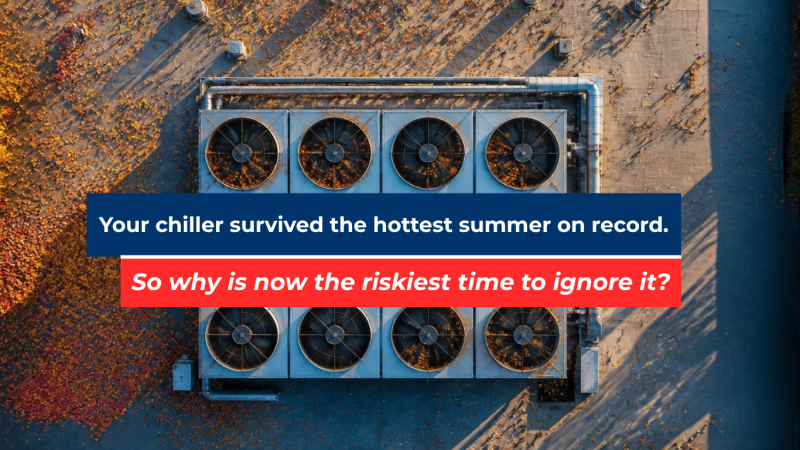
The Best Time to Prepare Your Chiller for Next Summer? Right Now.

Preparing Schools and Universities for Winter HVAC Demand