Heating and Cooling at the Same Time: Is Your Factory Missing an Energy-Saving Opportunity?
If your factory runs industrial chillers to cool a process while a gas boiler heats the offices, washdown water or a drying line next door, you are paying twice for the same energy. The chiller pumps heat out of your process and dumps it into the air. The boiler burns gas to make heat you have just thrown away.
That is simultaneous heating and cooling demand, and it is far more common than most site managers realise. Across UK industry, heating accounted for 54.1% of the 270 TWh consumed in 2019, with cooling adding a further 4.1%, according to research synthesised for the Energy Institute. The same work cites a 2021 UK government study estimating roughly 62 TWh a year of industrial waste heat escaping through exhaust, cooling liquid and radiant heat.
A polyvalent heat pump, also called a four-pipe chiller or simultaneous heat recovery chiller, captures that wasted heat and puts it to work. This guide explains which sites qualify, how the technology works in plain English, and how to judge the return before you spend a penny. It is written by the engineering team at Cooltherm, which has designed, installed and maintained chiller and heat pump plant across the UK since 1992.
In brief
- Simultaneous demand means one part of your site needs cooling while another needs heating at the same time.
- Separate chillers and boilers reject heat on one side and burn fuel on the other.
- Polyvalent (four-pipe) units serve both loops from one machine, recovering heat instead of rejecting it.
- When loads are balanced, each kilowatt of electricity can deliver useful heating and cooling together, measured as Total Efficiency Ratio (TER).
- The best candidates run year-round process cooling alongside steady low-temperature heat demand.
What is simultaneous heating and cooling demand?
What is simultaneous heating and cooling demand?
Simultaneous heating and cooling demand is when a site needs heat removed from one place and heat added somewhere else at the same moment. It is not about summer versus winter. It happens hour by hour, all year round.
The classic examples sit side by side on the same site:
- Cooling: injection moulding tools, extruders, compressors, server rooms, cold stores, product chilling, laboratory equipment.
- Heating: office and welfare space, domestic hot water, CIP and washdown water, pre-heating of process fluids, drying, air handling unit reheat.
The Eurovent industry association describes the ideal application as one with consistent contemporary demand for heating and cooling. In other words, the two loads overlap for many hours of the year, not just occasionally.
Industrial sites are often better suited than commercial buildings. Process cooling usually runs whatever the weather, so there is a dependable source of recoverable heat every working hour.
Which industrial sites have simultaneous heating and cooling demand?
The strongest candidates pair year-round process cooling with steady, low-to-medium temperature heat demand. Heat recovery from process cooling works best when that heat can be used at roughly 45 to 60°C.
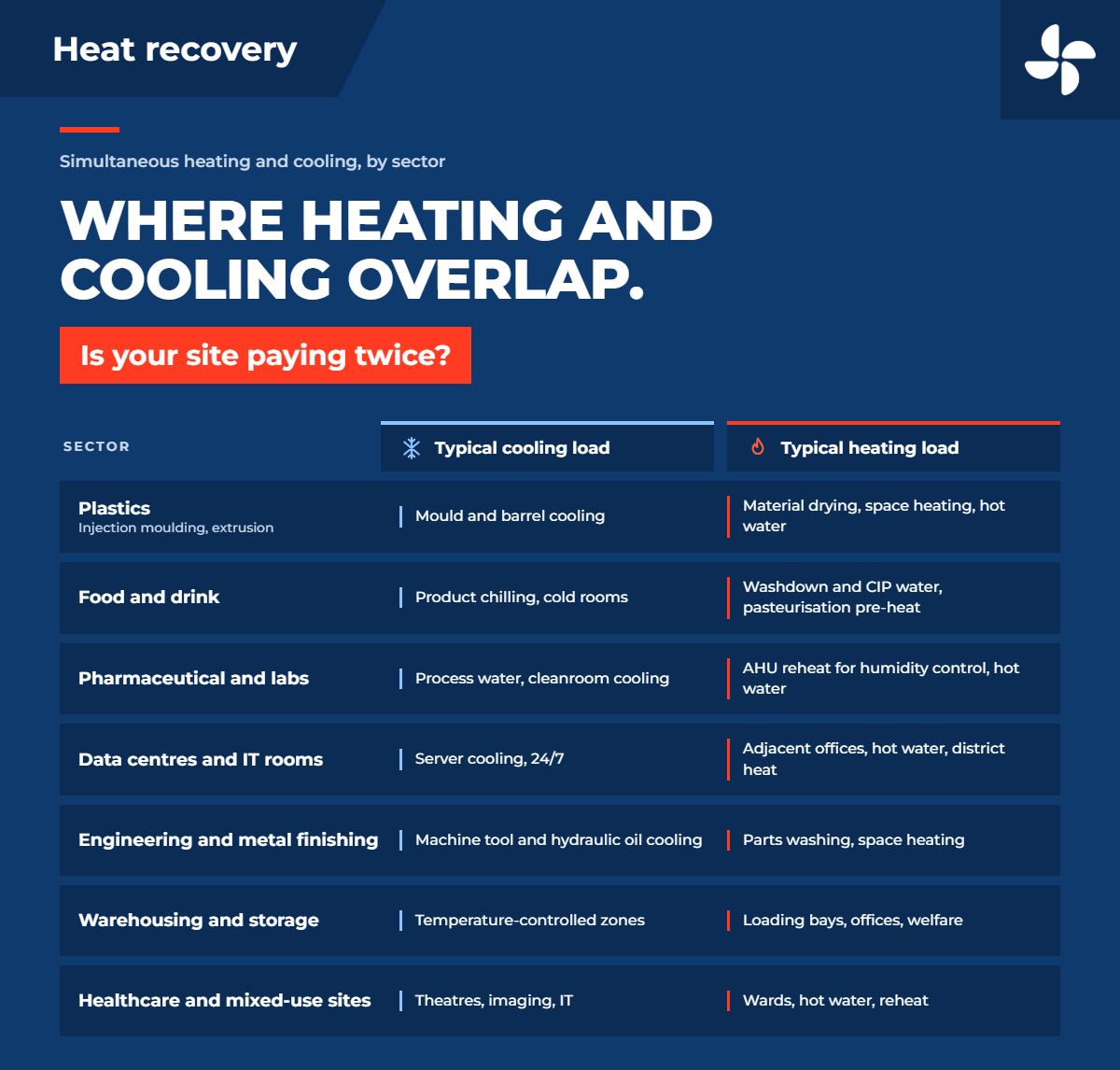
Plastics is a well-documented example. Italian trade press has highlighted how moulding and extrusion plants increasingly need warm and cold water at the same time, with winter process heat recoverable for hot water or underfloor heating at no extra energy cost.
One often-missed load is reheat. Air handling units that dehumidify by overcooling air, then reheat it, create simultaneous demand inside a single piece of plant. Pharmaceutical, food and electronics sites with tight humidity control frequently fall into this category.
Cooltherm works across factory and manufacturing, data centre, healthcare and warehouse and storage sites, where these overlapping loads show up again and again.
Why do separate industrial chillers and boilers waste energy?
A conventional site uses two independent systems: industrial chillers for the cold side, gas boilers for the hot side. Each is efficient at its own job. Together, they work against each other.
Here is what happens in a typical hour:
- The chiller absorbs heat from your process water.
- It adds the compressor's own energy, then rejects all of that heat to atmosphere through dry coolers or condenser fans.
- Meanwhile, the boiler burns gas to heat water for washdown, offices or reheat.
- You pay for electricity to throw heat away and gas to make it again.
This is why the Eurovent STER recommendation notes that existing efficiency ratings do not properly value polyvalent units. A chiller judged only on cooling, and a heater judged only on heating, both miss the energy flowing between them.
There are hidden costs too:
- Two plant rooms' worth of maintenance, servicing and F-Gas checks.
- Combustion emissions on site, which matter for net zero reporting and any carbon pricing exposure.
- Heat rejection noise and fan energy on the chiller side, running hardest when you need the heat most.

With separate plant, the chiller's heat goes to atmosphere while the boiler burns gas. A four-pipe unit sends that same heat to your heating loads.
How do simultaneous, polyvalent and four-pipe chillers work?
They are one machine that makes chilled water and hot water at the same time, on two separate loops. Heat taken out of the chilled loop is moved into the hot loop instead of being dumped outside.
What is a polyvalent chiller?
A polyvalent unit is defined by Eurovent as a machine that provides heating and cooling on two separate, independent water or brine loops using the vapour compression cycle. Each refrigerant circuit has three heat exchangers:
- A cold exchanger, connected to your chilled water loop.
- A hot exchanger, connected to your heating loop.
- A source exchanger, usually air-side coils, which can reject surplus heat or absorb extra heat when needed.
When heating and cooling demand are balanced, the source exchanger does not run at all. Every unit of heat removed from the process ends up in the hot water loop. Eurovent describes this as the point of maximum energy recovery.
Polyvalent, four-pipe, simultaneous: what is the difference?
Mostly, nothing. They are three names for the same idea.
- Polyvalent heat pump is the term used by Eurovent and many European manufacturers.
- Four-pipe chiller or 4-pipe heat pump describes the plumbing: two pipes for the chilled loop, two for the hot loop.
- Simultaneous heating and cooling unit describes what it does.
They are not the same as:
- A reversible heat pump, which switches between heating and cooling but cannot do both at once.
- A 2+2-pipe unit, which Eurovent separates out as a reversible unit with an extra exchanger for domestic hot water.
- A chiller with partial heat recovery, such as a desuperheater, which only captures a slice of the rejected heat.
What operating modes does a four-pipe unit use?
The controls choose the mode automatically from live demand, with no seasonal changeover.
- Cooling only: works as a standard chiller, rejecting heat to air.
- Heating only: works as an air source heat pump.
- Full heat recovery: cooling and heating balanced, no heat rejected.
- Recovery plus cooling: heating met in full, surplus heat rejected to air.
- Recovery plus heating: cooling met in full, extra heat drawn from the air.
Cooltherm's Energy Power range is an example of this technology: air-cooled 4-pipe units delivering simultaneous cooling, heating and domestic hot water at capacities up to 1,133 kW. For a refresher on the fundamentals, see how does a chiller work? and how does a heat pump work?
What is the ROI of a polyvalent heat pump?
The return comes from replacing boiler fuel with heat you are already producing. The more hours your heating and cooling loads overlap, the faster the payback.
How is efficiency measured? TER explained
Standard chillers are rated by EER (cooling out per kW of electricity). Heat pumps are rated by COP (heating out per kW). Neither captures a machine doing both jobs at once, so Eurovent created a dedicated metric, the Total Efficiency Ratio:
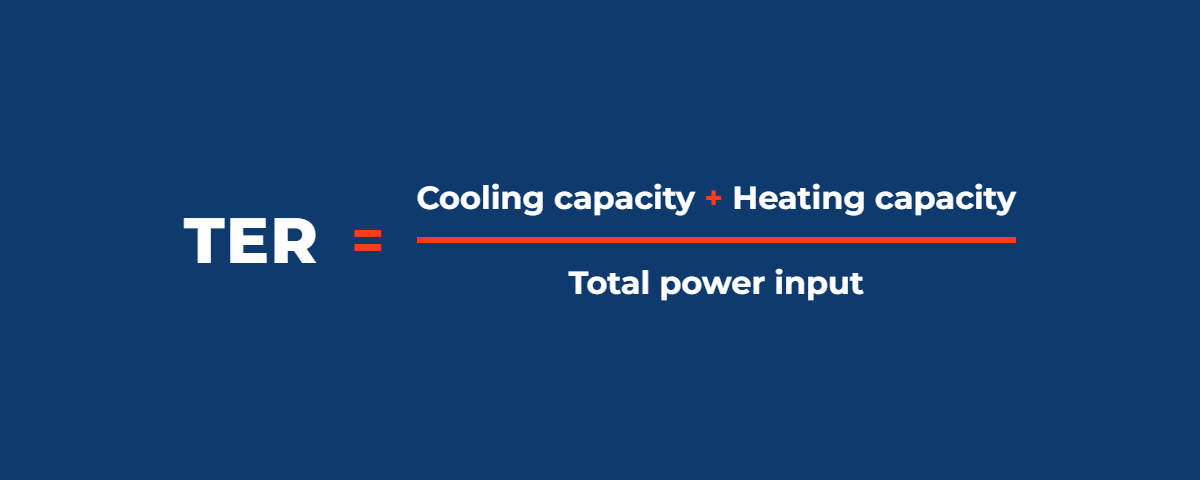
Because both outputs are useful, TER figures are much higher than a chiller's EER alone. Bear in mind TER is a full-load rating at fixed conditions. Eurovent's 2023 STER recommendation proposes a seasonal version that reflects real part-load operation across the year.
What drives the payback?
- Hours of overlap. Year-round process cooling plus year-round hot water is the sweet spot.
- Load balance. The closer heating and cooling are in size, the more heat is fully recovered.
- Hot water temperature. Lower is better. Heating at 45 to 50°C is far more efficient than 70°C or above.
- Gas versus electricity prices. The spark gap on your contracts sets the value of each kWh of gas displaced.
- Existing plant age. Replacing an end-of-life chiller or boiler improves the case, since part of the spend was due anyway.
- Carbon value. Removing on-site combustion supports net zero targets and SECR reporting.
How does Cooltherm assess a site for heat recovery?
We start with your loads, not a product. A polyvalent unit only earns its keep when it is sized to real, overlapping demand.
- Site survey. An engineer reviews existing chillers, boilers, process loads and operating hours. Book a site survey.
- Load profiling. We map when heating and cooling run, and how much overlaps, using metering or BMS data where available.
- Options appraisal. Our design service compares four-pipe units, heat recovery chillers and conventional upgrades side by side, with running cost and carbon estimates.
- Installation. Turnkey installation planned around production, so your process keeps running.
- Ongoing support. Service and maintenance contracts with 24/7 call-out, plus F-Gas compliance support.
Why Cooltherm?
- Specialists since 1992, part of the Carver Group, an eighth-generation British engineering group.
- Four regional offices and an extensive team of experienced engineers covering the UK.
- Accredited: ISO 9001, ISO 14001 and ISO 45001, plus REFCOM, SafeContractor, CHAS and Constructionline.
- Proven in critical environments: see how we helped deliver over £100,000 in savings at Vodafone's Newbury testing facility, and bespoke process cooling for the subsea pipe industry.
More projects are in our case studies.
Frequently asked questions
What is simultaneous heating and cooling?https://www.cooltherm.co.uk/contact/request-a-quote
It is when one part of a site needs cooling and another needs heating at the same time. A polyvalent or four-pipe unit meets both from one machine, moving heat from the cold loop to the hot loop instead of rejecting it.
What is a polyvalent chiller?
A polyvalent chiller, or polyvalent heat pump, produces chilled water and hot water on two independent loops at once. It has three heat exchangers per circuit: cold, hot and an air or water source for balancing.
Is a four-pipe chiller the same as a heat recovery chiller?
Not quite. A four-pipe chiller can recover all of its rejected heat and also run as a standalone chiller or heat pump. Many heat recovery chillers only capture part of the heat, for example through a desuperheater.
What is TER?
Total Efficiency Ratio is the combined heating and cooling output divided by electrical input. It is the standard Eurovent metric for polyvalent units, because EER and COP each count only one useful output.
Can heat recovery from process cooling replace my gas boiler?
Often in part, sometimes entirely. It depends on how much heat you need, at what temperature, and how often it overlaps with cooling. A site survey confirms how much boiler load can be displaced.
What hot water temperature can a four-pipe unit produce?
Typically up to around 50 to 60°C, depending on the model and conditions. Cooltherm's Energy Power heat pumps deliver hot water up to 50°C, and booster units can lift water to 80°C where needed.
Do polyvalent units work in winter?
Yes. With no seasonal changeover, they run all year. In winter, process cooling becomes a free heat source for the site.
How quickly do polyvalent heat pumps pay back?
Payback depends on overlapping hours, load balance, hot water temperature and your gas and electricity prices. Sites with year-round process cooling and steady heat demand usually see the strongest case. We model it for your site before you commit.
Stop paying twice for the same heat
If your industrial chillers are rejecting heat while your boilers burn gas a few metres away, there is energy on the table. A polyvalent heat pump could turn that waste into your cheapest source of heat.
The first step is a straightforward conversation. One of our engineers will review your process cooling, heating loads and operating hours, then tell you straight whether simultaneous heating and cooling makes sense for your site.
Book your site survey or call our national team on 01179 610006.
Prefer to start with numbers? Request a quote and share your current plant details.
Related News

The Best Time to Prepare Your Chiller for Next Summer? Right Now.

Preparing Schools and Universities for Winter HVAC Demand