Repair or Replace? Making the Right Decision for Your Turbocor Chiller

When a Turbocor chiller faults, the question arrives quickly: is this a chiller repair, or is it time for chiller replacement? For most plant, age and wear make the answer fairly predictable. A Turbocor chiller is different, and the usual rules of thumb can push you towards the wrong decision.
The reason is the compressor. A Danfoss Turbocor compressor runs without oil on magnetic bearings, so it does not wear or lose efficiency the way a conventional machine does. That changes what is worth repairing, what is worth replacing, and who is qualified to tell you which.
This guide is for facilities managers, estates teams and consultants responsible for a Turbocor chiller in a data centre, hospital, commercial building or process site. It covers how the technology ages, the warning signs to act on, how refrigerant rules and lifecycle cost shape the decision, and why access to genuine Danfoss parts and support often settles it.
How does a Turbocor chiller work, and why does it change the repair-or-replace decision?
A Turbocor chiller uses a variable-speed centrifugal compressor whose shaft floats on magnetic bearings, so there is no oil and no metal-to-metal contact. Danfoss describes it as the first oil-free magnetic bearing compressor for the HVAC industry.
Three design features matter when you are weighing up repair against replacement:
- Magnetic bearings. Sensors check the shaft position 100,000 times per second, holding it clear of any wear surface.
- Integrated variable-speed drive. The compressor slows as load or condensing temperature falls. Danfoss puts the energy saving at up to 50%.
- Soft start. Start-up current is just 2 amps, which spares electrical components the stress of a conventional start.
The practical consequence is that a Turbocor compressor holds its efficiency. A Danfoss study found consistent performance after more than ten years of operation, and one monitored data centre chiller showed no significant degradation over 11 years.
Compare that with oil-lubricated chillers. Research cited by Danfoss recorded a 10% efficiency loss after five years and 20% after ten, as oil coats the heat exchanger tubes.
So on a conventional chiller, age alone builds a case for replacement. On a Turbocor chiller it does not. The compressor mechanics are rarely the weak point. The power electronics, the controls, the refrigerant and the rest of the chiller usually are.
What are the warning signs that a Turbocor chiller needs attention?
Most Turbocor problems announce themselves through the compressor's own diagnostics well before a hard failure. Act on these signs early and the repair option stays open.
- Recurring bearing or drive alarms. Repeated faults on the bearing control or inverter point to electronics that need investigation, not a reset
- Nuisance trips after power disturbances. Poor power quality is hard on drive components, and trips that follow dips or spikes are worth tracing.
- Ageing capacitors. The DC bus capacitors are an age-related service item. Follow the Danfoss replacement interval, because a failure here can damage other components.
- Surge or instability at low load. This can indicate a controls, sensor or system-side issue such as fouled heat exchangers or low refrigerant charge.
- Refrigerant top-ups. Repeated top-ups mean a leak. That is an F-Gas compliance issue as well as a performance one.
- Rising energy use at the same load. The compressor should not drift. If consumption climbs, look at the heat exchangers, controls and charge.
- Obsolete controls or unsupported parts. If the chiller controller can no longer be supported, repair gets slower and riskier each year.
A structured chiller maintenance contract picks most of these up at a routine visit. For more on timing, see the best time to prepare your chiller for next summer.
When does Turbocor compressor repair make sense?
Repair is usually the right call when the fault is confined to the compressor's electronics or serviceable components and the rest of the chiller is sound. Because the compressor does not degrade mechanically, a properly repaired Turbocor chiller can return to its original efficiency.
Turbocor compressor repair makes sense when:
- The fault is in a replaceable module, such as a power electronics board, capacitor set, sensor or valve.
- The heat exchangers, pipework, frame and controls are in good condition.
- Genuine parts are available quickly, so downtime is short.
- The chiller still matches the building's cooling load.
- The refrigerant has a workable future on your site.
There is also a middle route. Where a compressor is beyond economic repair, a like-for-like compressor exchange can restore the chiller without the cost and disruption of replacing the whole machine. Whether that suits your unit depends on the compressor model and Danfoss approval, so it needs an engineer's assessment.
One caution. A repair is only as good as the diagnosis behind it. Swapping parts until the alarm clears is expensive and leaves the root cause in place.
When is chiller replacement the better investment?
Chiller replacement is the better investment when the problem is the chiller around the compressor, or when the building has outgrown the machine. On a Turbocor chiller, replacement is seldom justified by compressor efficiency alone.
Replacement tends to win when:
- The chiller itself is failing. Corroded coils, leaking heat exchangers or a deteriorating frame cannot be fixed by a compressor repair.
- Faults keep recurring. Several major repairs in a short period suggest systemic problems, and the downtime cost mounts.
- The load has changed. A chiller that is badly oversized or undersized for today's demand wastes energy however well it runs.
- The refrigerant is a liability. An older unit on a high-GWP refrigerant carries rising cost and supply risk.
- You need new capability. Free cooling, heat recovery or lower noise may be worth more than a repair can deliver.
- Downtime is intolerable. In critical cooling, planned replacement beats an unplanned failure.
Current Turbocor chillers have moved on. Cooltherm's Turbocor chiller range covers air-cooled and water-cooled units up to 3,900 kW, uses R513A or HFO R1234ze, and runs down to 67 dB(A). The TurboLine models add free cooling and operate in ambient temperatures as low as -20°C.
How do F-Gas refrigerant rules affect the decision?
F-Gas rules do not force you to replace a working Turbocor chiller, but they steadily raise the cost and risk of keeping an older one on a high-GWP refrigerant. Many earlier Turbocor chillers run on R134a, an HFC with a global warming potential of 1,430.
The key facts for UK operators:
- Great Britain is phasing down HFCs by 79% by 2030, against a 2009 to 2012 baseline.
- Defra consulted in late 2025 on tightening that schedule from 2027, with further steps to 2050.
- Industry reporting in June 2026 described a 23% cut in HFC quota from 1 January 2027 as already committed.
- The existing ban on servicing with virgin refrigerant applies to gases with a GWP above 2,500, so R134a chillers can still be serviced legally.
The risk, then, is commercial. As quota shrinks, higher-GWP refrigerant becomes scarcer and dearer, and every leak costs more to put right.
That feeds directly into the repair-or-replace sum. A sound, leak-tight R134a chiller may have years of economic life left. One that needs regular top-ups is a stronger candidate for replacement with a unit on R513A or ultra-low-GWP R1234ze.
Cooltherm's F-Gas compliance service can confirm where your plant stands on leak checks and record keeping.
What is the ROI of repairing versus replacing a Turbocor chiller?
The ROI comes from comparing whole-life cost over the same period, not the repair quote against the price of a new chiller. Put both options on one timeline, typically the remaining economic life of the existing machine.
For each option, add up:
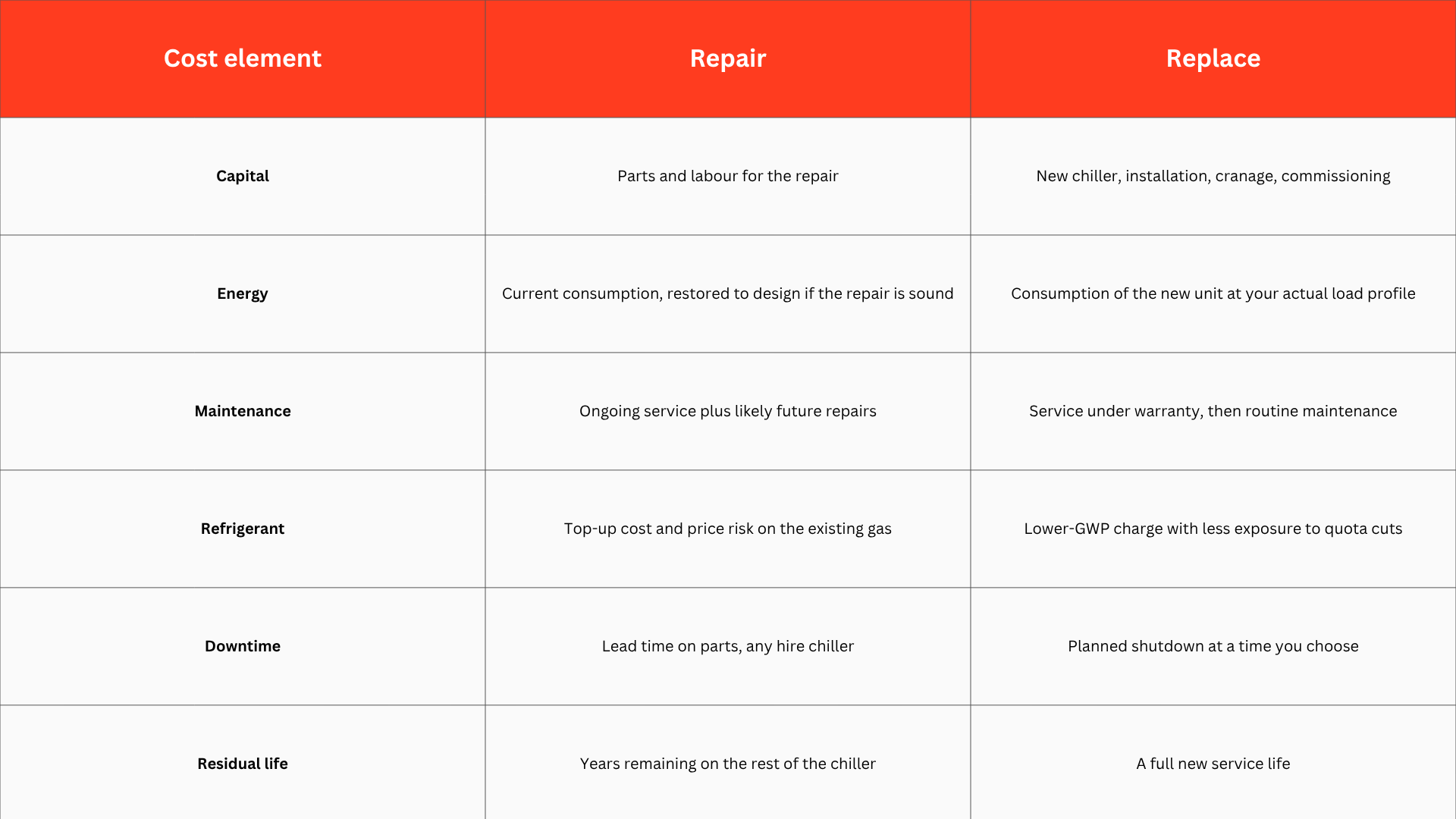
Two reference points help with the timeline. CIBSE publishes economic life expectancy tables under Guide M11, with variation factors for how hard an asset has worked. Danfoss literature cites a 23-year chiller life expectancy from the ASHRAE Handbook.
A common rule of thumb says replace when a repair costs more than half the price of new plant. Treat it with care on a Turbocor chiller. Because the compressor does not lose efficiency with age, a significant repair on an otherwise healthy machine can still be the better return.
The energy line deserves the closest scrutiny. If a replacement is being justified on efficiency, ask for the saving to be modelled at your part-load profile, not at a single full-load rating.
Why does it matter who services your Turbocor chiller?
It matters because the repair option only exists if someone can diagnose the fault correctly and get the right part quickly. On a Turbocor chiller, both depend on the service provider's relationship with Danfoss.
Danfoss supports its compressors through chiller manufacturers and a network of independent Turbocor Approved Service Providers. It describes these providers as properly trained, with access to original Danfoss spare parts.
Cooltherm is an accredited Danfoss Turbocor Approved Service Provider (TASP) for the UK. In practice, that gives Turbocor owners:
- Priority access to genuine parts. Cooltherm has priority access to Danfoss Turbocor compressor parts and holds critical spares in stock.
- Direct Danfoss technical support. Engineers can call on Danfoss for diagnostics, performance optimisation and component servicing.
- Current technical information. Product updates and technical bulletins arrive as they are issued, across the Turbocor compressor range.
- Official listing. Cooltherm appears on the Danfoss TASP directory, so you can verify the accreditation yourself.
Here is why that bears on repair or replace. A fault that is repairable in days with the part on the shelf can become a forced replacement, or weeks on a hire chiller, when the part or the expertise is missing. Good access to parts keeps the cheaper option alive.
There is a second benefit. Cooltherm services Turbocor compressors and also supplies new Turbocor chillers, backed by an extensive team of experienced engineers. The recommendation you get can go either way, based on what the machine needs.
One practical note: if your chiller is still under warranty, Danfoss advises contacting the chiller manufacturer first.
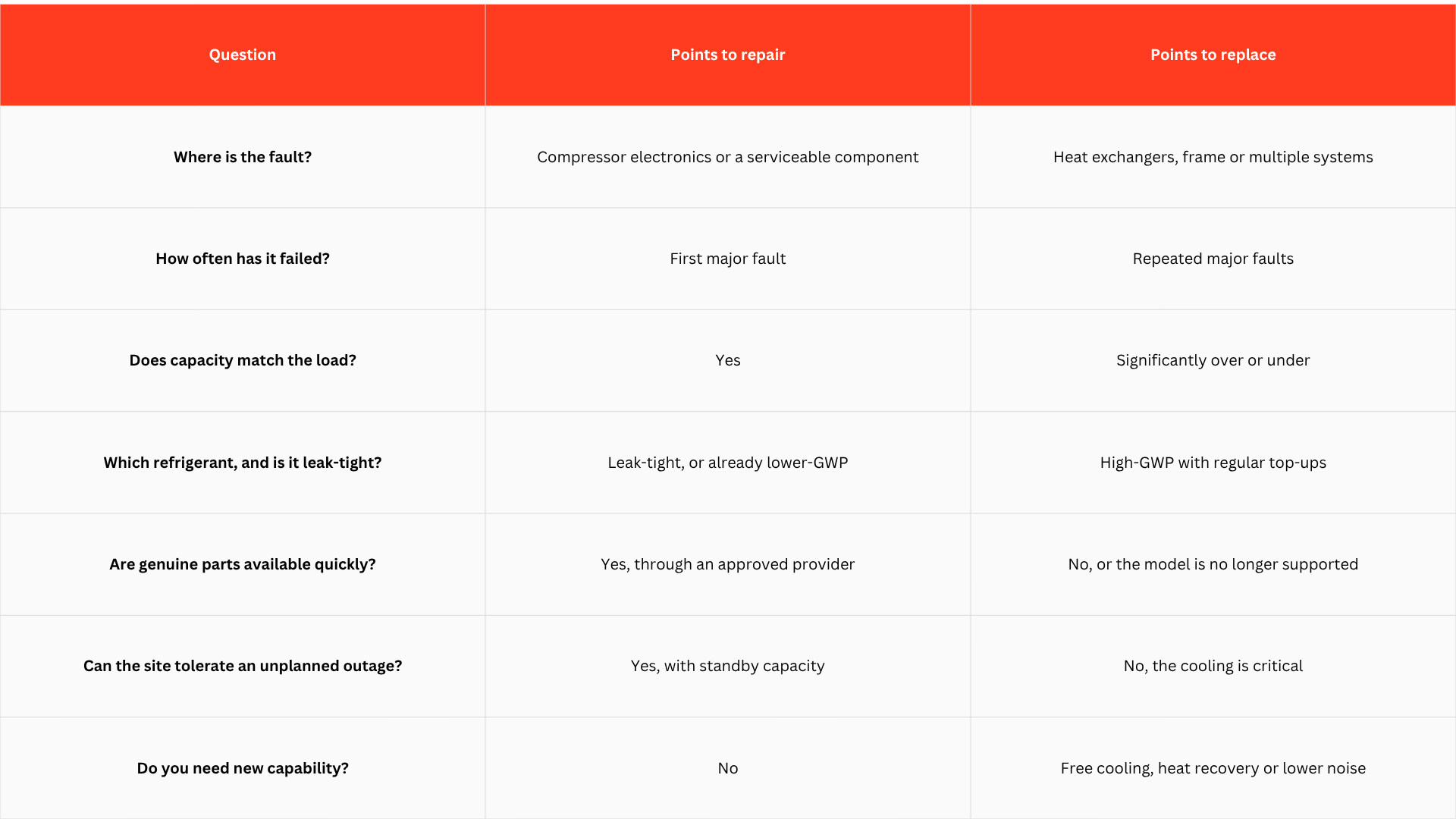
Repair or replace: a quick decision checklist
Use this table as a first pass before commissioning a survey. If most of your answers sit in one column, that is your likely direction.
Frequently asked questions
Is it worth repairing a Turbocor compressor?
Usually, yes. A Turbocor compressor runs oil-free on magnetic bearings and holds its efficiency over time, so a correct repair with genuine parts can restore original performance. Repair stops making sense when the wider chiller is failing or faults keep returning.
How long does a Turbocor chiller last?
There is no single figure, because life depends on duty, environment and maintenance. Danfoss has documented Turbocor compressors performing consistently after more than ten years, and its literature cites a 23-year chiller life expectancy from ASHRAE. CIBSE Guide M11 provides UK life expectancy tables for planning.
Can an R134a Turbocor chiller still be serviced in the UK?
Yes. The current servicing ban covers virgin refrigerants with a GWP above 2,500, and R134a sits below that at 1,430. The HFC phase-down is reducing supply, though, so expect the cost of R134a to rise and fix leaks promptly.
What is a Danfoss Turbocor Approved Service Provider?
It is an independent service company accredited by Danfoss to work on Turbocor compressors. Approved providers are trained by Danfoss and have access to original spare parts. Cooltherm holds this accreditation for the UK.
Where can I get genuine Turbocor compressor parts in the UK?
From the chiller manufacturer or a Danfoss Turbocor Approved Service Provider. Cooltherm has priority access to Danfoss Turbocor compressor parts and stocks critical spares, available through its spare parts service.
How do I compare chiller repair cost with chiller replacement cost?
Compare whole-life cost over the same number of years. Include capital, energy, maintenance, refrigerant and downtime for each option. A repair quote set against a new chiller price on its own will mislead you.
How quickly should I act on a Turbocor fault alarm?
Straight away. Turbocor compressors report faults early through their diagnostics. Investigating a recurring alarm promptly usually keeps the problem small and the repair option open.
Get a straight answer on your Turbocor chiller
If you are weighing up repair or replacement, start with evidence. A Cooltherm engineer will assess the compressor, the chiller and the refrigerant position, then give you a costed recommendation for both routes.
As a Danfoss Turbocor Approved Service Provider and a supplier of new Turbocor chillers, Cooltherm can deliver whichever option the numbers support.
- Book a site survey
- Request a quote
- Call the national team on 01179 610006
Want to see the work first? Browse Cooltherm's case studies, or read how Cooltherm supports data centres and healthcare sites.
Related News

R-410A is the next R-404A: what it means for your chillers and comfort cooling

Heating and Cooling at the Same Time: Is Your Factory Missing an Energy-Saving Opportunity?