Should UK Chillers Be Designed for 40°C Ambient Temperatures?
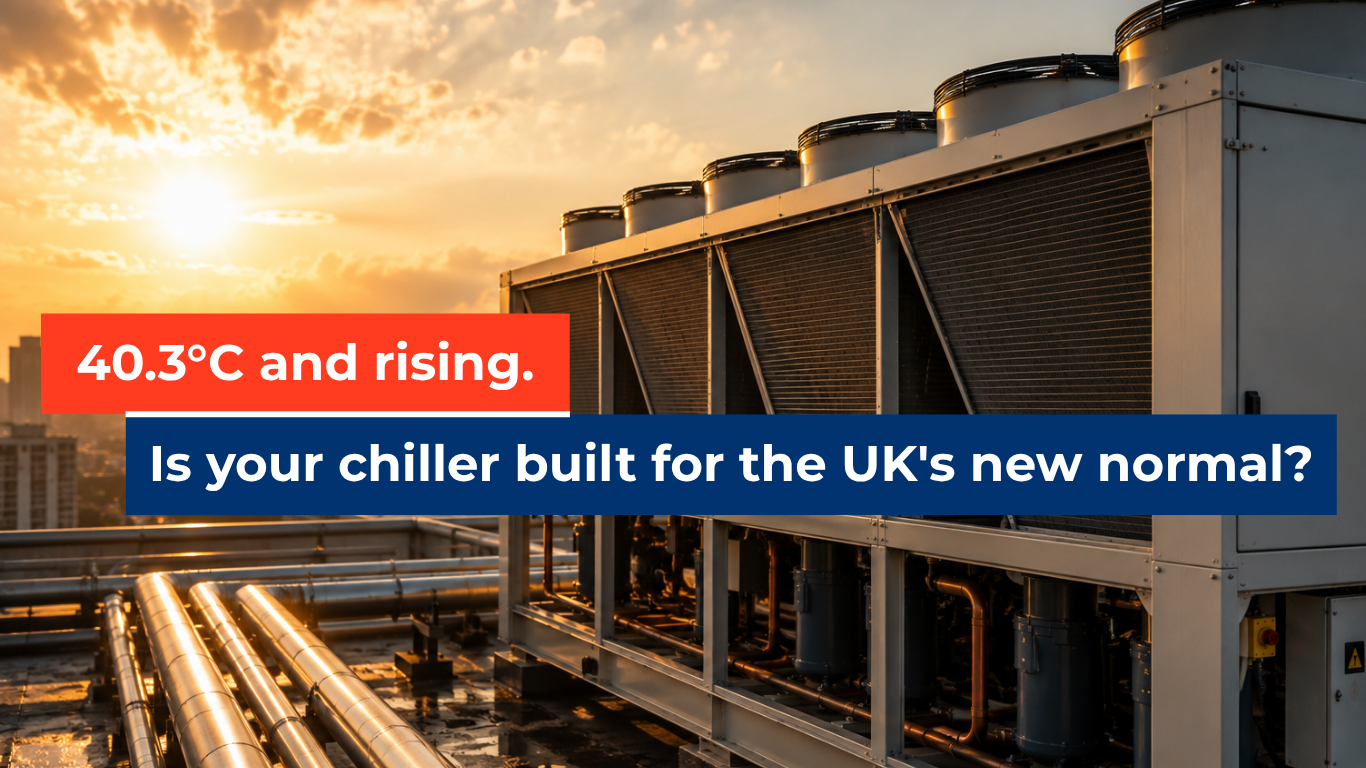
For decades, industrial chillers UK manufacturers built and specified equipment around a simple assumption: British summers are mild. Air-cooled condensers, fan arrays and refrigerant circuits were sized against ambient design temperatures in the low-to-mid 30s°C, because that comfortably covered "a hot day in Britain." That assumption no longer holds.
On 19 July 2022, the UK recorded an air temperature of 40.3°C at Coningsby, Lincolnshire - the first time 40°C had ever been observed in this country, and a jump of 1.6°C above the previous national record. Six additional locations also reached or exceeded 40°C that day. The Met Office has since confirmed that human-induced climate change made this event around ten times more likely, and that without it, a UK 40°C day would have been "extremely unlikely." For any facilities manager, consultant or process engineer responsible for cold storage, food production, data centres or pharmaceutical manufacturing, that single data point should change how the next chiller is specified.
This article unpacks the chiller ambient design temperature question in detail: what "designed for 40°C" actually means, how UK climate data and design standards are evolving, what happens when a chiller runs outside its design envelope, and how to specify equipment that will still be performing reliably in 2040, 2050 and beyond.
What Does "Designed for a 40°C Ambient Temperature" Actually Mean?
When engineers talk about a chiller's ambient design temperature, they mean the maximum outdoor air temperature the unit is guaranteed to deliver its full rated cooling capacity at, without the compressor tripping on high head pressure or the manufacturer's performance data becoming invalid.
Under the European rating standard EN 14511 (the series used to test and declare capacity, power input and efficiency for liquid chilling packages and process chillers), the industry-standard rating point for air-cooled units has traditionally been an ambient of 35°C. That figure was chosen because it represented a realistic "hot day" ceiling across much of temperate Europe, including the UK, at the time the standard was developed.
A chiller "designed for 40°C ambient" is one where:
- The compressor envelope, condenser coil surface area, and fan/EC-motor airflow are all sized with headroom above the EN 14511 35°C rating point.
- Full-load cooling capacity — not a derated, reduced output — is maintained up to and including 40°C dry-bulb ambient.
- Head pressure, discharge temperature and refrigerant charge management remain within safe operating limits at that extreme, rather than triggering high-pressure safety cut-outs.
In practice, this means larger condenser coils, higher airflow fan configurations, electronic expansion valves capable of wider modulation, and often a compressor selection with a wider operating envelope than a standard "off-the-shelf" UK-spec unit.
How Hot Is the UK Actually Getting?
This is the question that should sit behind every chiller specification decision made today. The data is unambiguous, and it points in one direction.
- 40.3°C was recorded at Coningsby, Lincolnshire on 19 July 2022 — a new UK record, exceeding the previous record (38.7°C, set in Cambridge in 2019) by 1.6°C.
- 46 UK weather stations exceeded the former national temperature record that day, and seven stations reached or passed 40°C for the first time in the UK's observational history.
- Overnight temperatures broke records too: 25.8°C was recorded at Kenley, Surrey — an indicator that even nighttime "free cooling" hours, which many chiller plants rely on to recover, are shrinking.
- Met Office analysis found that in today's climate, a 40°C UK day has a return period in the region of 1-in-100 to 1-in-300 years — but under a moderate emissions scenario that shortens to roughly 1-in-15 years by 2100, and to as little as 1-in-3 to 1-in-4 years under a high-emissions scenario.
- Of the 30 hottest days ever recorded by UK area-average temperature, close to half occurred in the current century, and the UK's ten warmest years on record have all occurred since 2002.
None of this means 40°C ambient will be a routine Tuesday in Nuneaton or anywhere else in the UK. It does mean that equipment with no margin above the old 35°C rating point is now being asked to operate close to, or beyond, the edge of its design envelope during the very weeks - high summer, peak demand — when reliable cooling matters most.
What Ambient Temperature Are Most Existing UK Chillers Actually Designed For?
Here's the uncomfortable truth for a lot of UK plant rooms and rooftops: a large proportion of the chillers currently operating in cold storage, food processing, pharmaceutical and commercial buildings across the UK were selected and commissioned against a 32–35°C ambient design point, because that was the pragmatic, cost-effective standard for most of the units' service life.
That's not a manufacturing defect — it reflects historical UK climate norms and EN 14511's standard rating condition. The issue is that the climate those units were designed for no longer matches the climate they now operate in. A chiller with zero margin above 35°C, installed on a black-felt roof with poor airflow clearance, is exactly the kind of asset that struggles, or fails - during a red-warning heat event.
This is compounded by real-world derating factors that push the effective design margin even lower:
- Solar gain on rooftop condensers, which can add several degrees to the local air temperature the unit actually "sees" versus shaded weather-station readings.
- Recirculation and short-cycling of hot discharge air, especially where units are packed tightly together or boxed in by screening/acoustic enclosures.
- Urban heat island effects, which CIBSE's own weather guidance treats as a distinct and significant loading factor — see the next section.
- Fouled or under-maintained condenser coils, which reduce effective heat rejection capacity before ambient temperature is even a factor.
What Happens When a Chiller Runs Above Its Design Ambient Temperature?
When ambient air temperature exceeds a chiller's rated design point, the effects are not gradual — they tend to arrive in a cluster, and often on the single hottest afternoon of the year, which is precisely when cooling capacity matters most.
- Capacity falls just as demand peaks. As condensing temperature rises, the compressor's ability to reject heat efficiently drops, and available cooling capacity falls — commonly by several percent for every degree above the rated ambient. This is the opposite of what's needed, because cooling load (from solar gain, occupancy, refrigerated product turnover) is usually also at its highest.
- Head pressure safety trips. Once discharge pressure exceeds the compressor manufacturer's safe operating envelope, high-pressure cut-outs activate, shutting the compressor down entirely — sometimes for hours if the unit requires manual reset or engineer attendance.
- Reduced compressor lifespan. Compressors that are repeatedly pushed to the edge of their envelope experience elevated discharge temperatures, which accelerate oil breakdown, bearing wear and long-term reliability loss — even if a hard trip never occurs.
- Cascading process risk. In cold storage, this can mean product temperature excursions and food-safety non-conformances. In pharmaceutical manufacturing, it can mean GMP deviations. In server rooms and data halls, it can mean thermal shutdown of IT load.
- Energy efficiency collapses. COP (coefficient of performance) degrades sharply at high condensing temperatures, so even units that don't trip are burning meaningfully more electricity per kW of cooling delivered — a real cost even without a failure event.
The economic exposure here isn't hypothetical. A single cold-store temperature excursion can mean a full stock write-off; a single data hall thermal event can mean hours of downtime across mission-critical systems. Against that backdrop, the marginal capital cost of specifying additional ambient headroom at the design stage is small.
How Are UK Design Standards and Weather Data Responding to Climate Change?
The wider UK building services industry has already moved decisively away from historic "typical year" weather assumptions, and chiller specification is starting to follow.
CIBSE (the Chartered Institution of Building Services Engineers) now recommends the use of Design Summer Year (DSY) and future-projected weather files — CIBSE TM48 and TM49 — rather than older Test Reference Year data, specifically because TRY data represents average conditions and meaningfully understates real overheating and peak-cooling risk. TM52 sets the adaptive thermal comfort overheating criteria used to assess buildings against this data, and TM59 applies a minimum standard DSY1 (2020s, medium emissions) as the baseline for compliance assessments, with 2050s and 2080s projections available to stress-test designs where resilience matters most.
The practical implication for mechanical and process engineering is straightforward: if building overheating risk is now routinely assessed against future, climate-adjusted weather data rather than historic averages, chiller ambient design temperature should be assessed the same way. Specifying against a static 1990s-era "typical UK summer" figure is no longer defensible practice for any asset with a 15–20 year service life.
Progressive specification therefore increasingly follows a DSY-informed design ambient, rather than the EN 14511 default, particularly for:
- Cold storage and food distribution, where a single overheating event has direct food-safety consequences.
- Data centres and server rooms, where continuous cooling is a contractual SLA requirement.
- Pharmaceutical and healthcare cold-chain applications, where GMP compliance depends on temperature stability.
- Any rooftop plant with poor shading, restricted airflow clearance, or urban heat island exposure.
What Is the ROI of Designing a Chiller for 40°C Ambient Resilience?
This is the question that ultimately determines whether a facilities director signs off the additional specification. The honest answer is that the case rests on avoided-cost economics rather than a simple payback calculation, and it stacks up well under scrutiny.
The additional capital cost of specifying a chiller with genuine 40°C+ ambient headroom — larger condenser coils, higher-capacity EC fans, a wider compressor envelope, sometimes an adiabatic pre-cooling stage — typically sits in a modest single-digit percentage uplift over a standard 35°C-rated equivalent, because the core refrigeration circuit and controls are largely shared.
The avoided-cost side of the ledger is considerably larger:
- Downtime and lost production. A single compressor trip during a peak-demand heatwave can idle a production line, a cold store, or a server hall for hours — costs that dwarf the specification uplift many times over.
- Product and stock loss. For cold storage and food operators, a multi-hour cooling failure during a July heatwave can mean the loss of an entire chamber's stock.
- Compliance exposure. Temperature excursions in regulated environments (food safety, GMP pharmaceutical storage) carry both direct remediation cost and reputational/audit risk.
- Energy cost over the equipment's life. Because COP degrades sharply near and above the rated ambient limit, a unit with genuine headroom runs measurably more efficiently on the hottest days — which, given UK electricity pricing, is a real recurring saving, not just a resilience benefit.
- Insurance and business continuity terms. Increasingly, business continuity and insurance assessments are asking facilities to demonstrate climate resilience in critical plant — a documented 40°C design margin is a straightforward answer to that question.
Framed this way, the ROI case isn't really "should we spend more on a chiller" - it's "can we afford the exposure of not doing so," given that the UK now has direct, recorded, forty-degree evidence of what a bad summer looks like.
How Should Facilities Managers and Consultants Specify a Future-Proof Chiller?
For anyone writing a specification, tender, or replacement brief today, a small number of practical steps make the biggest difference to long-term resilience:
- State the design ambient explicitly in the spec — don't accept EN 14511's default 35°C by omission. Ask manufacturers to declare full-load capacity at 40°C ambient, not just the standard rating point.
- Request derating curves, not a single number. A reputable manufacturer can show capacity and COP across a full ambient range (25°C to 45°C+), which reveals how gracefully — or badly — a unit degrades under stress.
- Specify oversized or higher-airflow condenser coils rather than relying on compressor-side adjustments alone; heat rejection capacity is the first thing to run out of headroom in extreme ambient conditions.
- Consider adiabatic or evaporative pre-cooling of condenser inlet air for sites in the south and east of England, where the highest ambient extremes have historically been recorded.
- Review installation microclimate, not just the nameplate ambient rating — rooftop solar loading, airflow clearance, screening and unit spacing can add several effective degrees on the hottest days.
- Build in N+1 redundancy for critical cooling loads (cold storage, data halls, pharma), so a single high-ambient trip doesn't become a total loss of cooling.
- Use future-projected weather data (CIBSE TM49-style DSY files), not historic averages, when validating the design ambient against the equipment's expected service life.
Cooltherm's Approach to Climate-Resilient Chiller Design
Cooltherm designs and specifies chillers around the ambient reality UK sites now face, rather than the ambient assumptions of 20 years ago. That means condenser and airflow sizing with genuine headroom above EN 14511's 35°C rating point, transparent derating data across the full operating range, and specification support that accounts for site-specific microclimate factors like rooftop solar loading and airflow clearance — not just the nameplate rating.
For teams working across cold storage, food processing, pharmaceutical and process environments, Cooltherm's engineering team can review an existing chiller estate against current and projected UK ambient conditions, and recommend where headroom, redundancy or condenser upgrades will deliver the most resilience per pound spent. Explore Cooltherm's service and maintenance programme for proactive condenser health checks ahead of peak summer demand, or get in touch about a chiller ambient resilience review for sites with critical cooling loads.
Frequently Asked Questions
Is 40°C a realistic UK ambient design temperature?
Yes. The UK recorded 40.3°C in July 2022 — its first-ever 40°C reading — and Met Office analysis shows this kind of event is projected to become significantly more frequent, from roughly a 1-in-100-to-300-year event today to as often as 1-in-15 years by 2100 under moderate emissions. For critical cooling assets with a 15–20 year service life, 40°C is a realistic design consideration, not an extreme outlier.
What ambient temperature are most chillers designed for by default?
The standard EN 14511 rating condition used across the European air-cooled chiller industry is 35°C ambient. Equipment specified without additional headroom is rated to deliver full capacity only up to that point, after which performance and reliability begin to degrade.
What happens to a chiller's cooling capacity above its design ambient temperature?
Cooling capacity falls and energy consumption rises as condensing temperature increases, and once discharge pressure exceeds the compressor's safe operating envelope, high-pressure safety trips can shut the unit down entirely — typically at the exact moment of peak cooling demand.
Does designing for 40°C ambient cost significantly more?
The additional capital cost is typically a modest uplift over a standard 35°C-rated equivalent, since it mainly involves larger condenser coils and higher-capacity fans rather than a different core refrigeration architecture. This is generally small relative to the potential cost of a single heatwave-triggered downtime or stock-loss event.
How does climate change affect UK chiller specification standards?
UK building services guidance (CIBSE TM48/TM49/TM52/TM59) has already shifted from historic average weather data to Design Summer Year and future-projected climate data for assessing overheating risk. Chiller ambient design temperature is increasingly being assessed against the same forward-looking climate data rather than static historic norms.
Should existing chillers be retrofitted or checked ahead of a UK heatwave?
Yes - condenser coil cleanliness, airflow clearance and shading around rooftop units all affect the effective ambient temperature a chiller experiences, often adding several degrees beyond the official weather reading. A pre-summer service check is one of the lowest-cost resilience measures available for existing plant.
Related News

Heating and Cooling at the Same Time: Is Your Factory Missing an Energy-Saving Opportunity?

The Best Time to Prepare Your Chiller for Next Summer? Right Now.